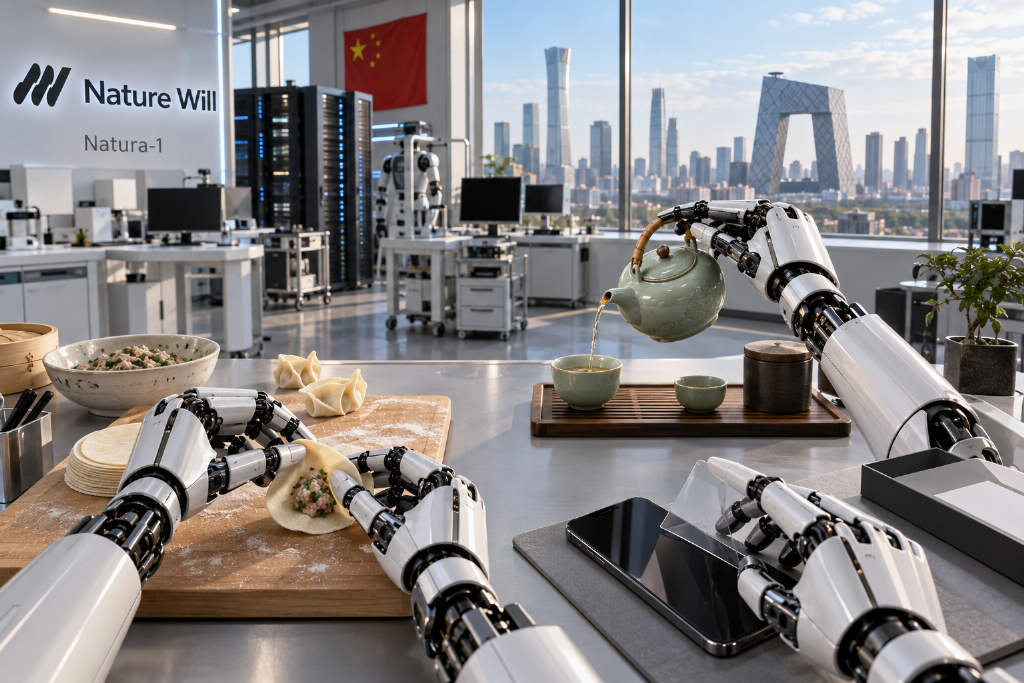
Nature Will2026-10-14 09:34:42Nature Will unveils Natura-1, a 50B model trained on 1 million hours of human experience for dexterous zero-shot roboticsBeijing-based embodied AI company Nature Will has introduced Natura-1, its first general foundation model for the physical world, built to connect large-scale human experience with real-world robot control. The model uses a 50-billion-parameter mixture-of-experts architecture and was pretrained on 1 million hours of first-person human experience data before being post-trained with a limited amount of robot data. According to the company, Natura-1 takes language and visual input and runs a 100-millisecond control loop for a 20-degree-of-freedom dexterous hand. The release is accompanied by a set of real-time, single-take demonstrations, including wrapping wontons, making tea, preparing a yogurt bowl, packing parcels, applying a phone screen protector, and writing calligraphy. Nature Will says the system is designed not only for fine-grained dexterous manipulation, but also for zero-shot instruction following on tasks that were not specifically collected or trained for during robot post-training. The company also shared benchmark results, scaling data, and infrastructure details, arguing that large-scale first-person human video can transfer to high-DoF robotic hands with less task-specific adaptation. It positions Natura-1 as an early attempt to combine dexterity and generalization in one model, while acknowledging that the source of some observed recovery and replanning behaviors still needs further study.130
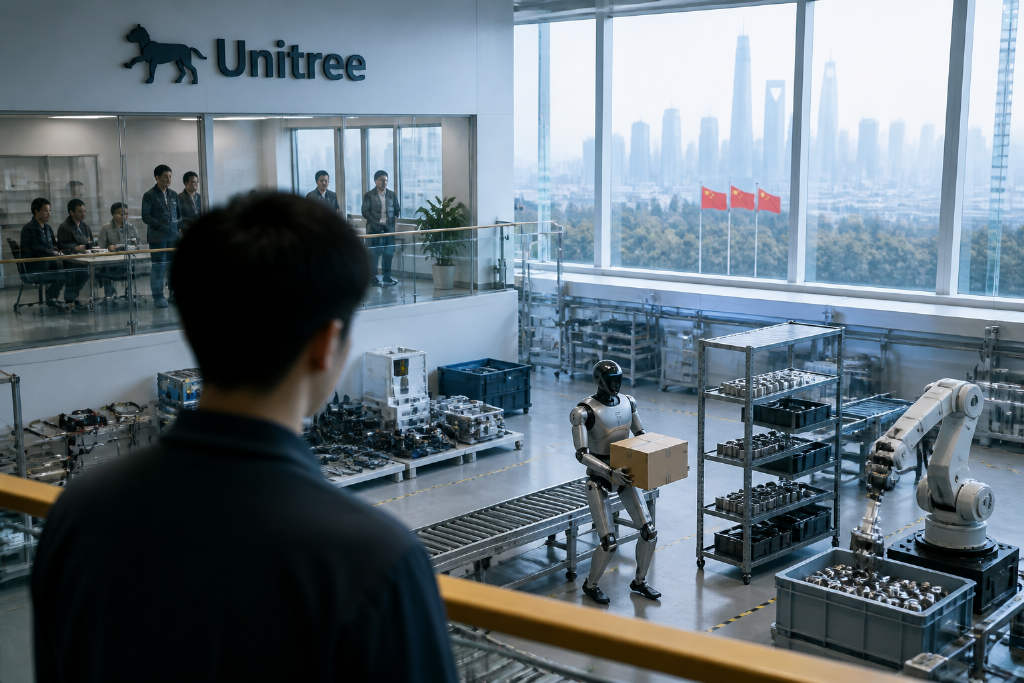
Embodied AI2026-08-23 05:19:00Embodied AI’s valuation surge runs ahead of proven demand, technology, and pricing logicA Late Post report cited by PANews paints a crowded and overheated embodied AI market in China, where capital has rushed into humanoid robots, dexterous hands, data collection, joint modules, and tactile sensors long before the sector has established durable industrial demand or a broadly accepted valuation framework. In the first half of 2026 alone, domestic embodied AI financing exceeded RMB 90 billion, and 22 companies were valued above RMB 10 billion, according to IT Juzi. Yet field observations described in the report show many robots still move too slowly for real factory deployment, while some revenue is tied to research, education, data collection loops, channel stocking, or related-party structures rather than large-scale end-user adoption. Unitree’s listing has become the market’s closest thing to a public benchmark. Morgan Stanley said more than 10,000 embodied robots were actually shipped in China last year, with Unitree accounting for 5,215 units. Its 2025 revenue reached RMB 1.699 billion, but the report notes that more than 70% of revenue as of last September came from research and education, and less than 10% came from industry applications. The broader question now is whether public markets will price Unitree as a high-growth embodied AI platform with future "brain" capabilities, or more like a strong engineering and hardware company. That answer may shape how long today’s private-market valuations can hold.1770
dexterous han2026-08-12 09:44:10Dexterous hand startups split into two camps as 2026 funding reaches RMB 28.51 billionA report cited by MarsBit and originally published by ITjuzi says China’s dexterous hand segment has logged 74 financing events involving 47 companies from January to Aug. 3, 2026, with disclosed funding totaling about RMB 28.51 billion. The report divides the field into two groups: 15 humanoid robot makers that develop dexterous hands in-house, and 32 third-party suppliers that sell complete hands or core components such as tactile sensors, micro motors, and precision screws. The funding gap between the two camps is wide. The 15 robot body makers accounted for 23 deals and about RMB 18 billion to RMB 20 billion in disclosed funding during the first seven months of the year, while the 32 suppliers completed 51 deals worth about RMB 8.51 billion. The report argues that in-house hand development has become a standard requirement for humanoid robot OEMs, but the deeper component stack remains largely outsourced. It also says the supplier side is fragmenting into three distinct tracks: complete dexterous hand module vendors, tactile sensing companies, and core drivetrain and transmission component makers. While complete-hand vendors are facing crowded competition, companies focused on tactile sensing and specialized parts are described as having stronger technical moats and a longer runway for commercialization.1140